Welcome to awslagi.com – Sharing AWS, Anthropic, Google Cloud, Microsoft Azure IT Exams. It's free for all!

Advanced Test Manager

Lead the testing effort and drive organizational success as an Advanced Test Manager.

4.8★★★★★(348 ratings)
18,922 studentsIntermediate
This certification validates your technical competence in managing the software testing process at an advanced level. You will master test strategy, team management, and how to ensure high-quality software delivery in complex enterprise environments. Become a respected leader in the industry. The Test Manager credential is a powerful catalyst for your career, proving you can handle the responsibility of delivering mission-critical software for global organizations.

What you'll learn

  • Advanced test management processes
  • - Risk-based testing strategy
  • - Managing test teams & vendors
  • - Incident & defect management
  • - Quality metrics and reporting

ATM

Lectures1
Questions32
Duration30 week
Students18,922

$20.00

Full Free Question Bank (32 Questions)

Advanced Test Manager (ATM) Practice Questions & Verified Answers

Click any option to test your knowledge, or reveal the verified answer and detailed explanation below each question.

Question #1Part 1Managing the Test Activities

You are the Test Manager for a project developing a Pay-TV company web customer portal that enables customers—with a smartcard and a set-top box—to buy digital content. On the **select** page, the system shows a dialog in which the customer can choose the digital-content items he or she is interested in. From this page, he or she can add one or more items to a shopping cart. An item comprises a product and a duration. There are three product types: Movie, sport, and premium (movie and sport). There are four possible durations: 1 months, 2 months, winter (from the beginning of January to the end of March), and summer (from the beginning of July to the end of September). Every combination of product and duration is permitted to define an item. Therefore, there are twelve possible items. A maximum of six distinct items may be added to the shopping cart at one time. When the customer chooses to check out, he or she goes to the **purchase** page, where the total cost of the shopping cart can be paid in three different ways: - using a credit voucher - using credit already charged on the smartcard - using a credit card (accepted credit cards are Visa, MasterCard, and Great Wall Card) The customer may log out from both the **select** and **purchase** pages. In that case, no purchase is made. You decide to use a blended risk-based and reactive testing strategy, and the following are a subset of the exit criteria for system testing: - EXCR1- Each "critical" quality risk item must be covered by at least one test condition - EXCR2- Each "critical" requirement must be covered by at least one test condition You are using a risk-based testing strategy. Test execution time is very limited. Assume all product risk items require approximately the same test effort. ![Question Image](https://cdn.examcademy.com/images/questions/1784712815866-y0xo5clt.jpg) Which of the following answers describes the best execution schedule in this scenario?
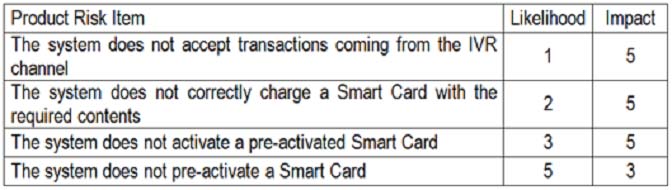
A1- Test the acceptance of transactions coming from the IVR channel2- Test the correct charge of the Smart Card with the required contents3- Test the correct pre-activation of the Smart Card4- Test the correct activation of the Smart Card
B1- Test the correct pre-activation of the Smart Card2- Test the correct charge of the Smart Card with the required contents3- Test the correct activation of the Smart Card4- Test the acceptance of transactions coming from the IVR channel
C1- Test the correct activation of the Smart Card2- Test the correct pre-activation of the Smart Card3- Test the correct charge of the Smart Card with the required contents4- Test the acceptance of transactions coming from the IVR channel
D1- Test the correct pre-activation of the Smart Card 2- Test the correct activation of the Smart Card3- Test the correct charge of the Smart Card with the
Question #2Part 1Managing the Product

Assume you are working on a CAS (Conditional Access System) for Pay-TV that enables authorized users to access, select, and transfer services and media. Authorized users may select services through different channels: Web Customer Portal, IVR (Interactive Voice Response), Call Centre, and SMS. The system uses a Smart Card to receive and decrypt the broadcast encrypted control words that permit decryption of pay-per-view TV. Each authorized user must have a Smart Card and a Set-Top Box to view the content. The following is an extract from the product risk analysis document: Both likelihood and impact are rated using this scale: (1 Very low, 2 Low, 3 Medium, 4 High, 5 Very High). The required test environment and code have been delivered. All test cases for every identified product-risk item have been written and are ready for execution. The database used to store the Smart Cards is empty; therefore, only new Smart Cards can be used during test execution. A Smart Card can be activated only if it was previously pre-activated. Thus, the post-conditions for executing the test cases that test pre-activation of the Smart Card are the pre-conditions for Smart Card activation. Which of the following statements is the most effective stakeholder contribution to completing the failure mode analysis table? ![Question Image](https://cdn.examcademy.com/images/questions/1784712815998-w969lmje.jpg)

AThe aircraft pilot and the customer representative should contribute to assess the detection. The chief software engineer, the system architect and the expert tester should contribute to assess the priority.
BThe aircraft pilot and the customer representative should contribute to assess the priority. The chief software engineer, the system architect and the expert tester should contribute to assess the detection.
CThe system architect and the chief software engineer should contribute to assess the priority. The expert tester is the only one who should contribute to assess the detection.
DThe aircraft pilot is the only one qualified to contribute to assess the priority and thus should be assigned this task. The customer representative should
Question #3Part 1Managing the Test Activities

The key objectives the senior management team seeks to achieve are: - to reduce costs associated with dynamic testing - to use reviews to ensure that the project remains on course for success and follows the plan - to use reviews as a well-documented and effective bug-removal activity that follows a formal process with clearly defined roles - to determine the effectiveness of reviews in terms of phase containment - to improve phase-containment effectiveness Which of the following answers would be expected to describe the best way to achieve these objectives?

AYou should plan for lightweight exit-phase reviews at the end of each development and testing phase, and plan for a process of gathering information from testing to perform an analysis aimed at identifying the larger cluster of defects
BYou should plan for formal exit-phase reviews at the end of each development and testing phase, and plan for a process of gathering information from testing to perform an analysis aimed at identifying the larger cluster of defects
CYou should plan for formal exit-phase reviews at the end of each development phase and testing phase, and plan for a process of gathering information from testing to perform an analysis of the bugs found during testing to determine the people responsible for those bugs
DYou should plan for formal exit-phase reviews at the end of each development and testing phase, and plan for a process of gathering information from testing
Question #4Part 1Managing the Test Activities

You are estimating the effort required for integration-testing activities in a new project. Consider the following factors, which may affect that estimate: 1. Availability of reusable test systems and documentation from earlier, similar projects 2. Unanticipated timing of component arrivals 3. Stability of the integration test team (no turnover) 4. Many geographically distributed sub-teams Which of the following statements is true?

AI. and II. can negatively affect the estimation III. and IV. usually favor the accuracy of the estimation effort
BII. and III. can negatively affect the estimation
Cand IV. usually favor the accuracy of the estimation effort
DII. and IV. can negatively affect the estimation
Eand III. usually favor the accuracy of the estimation effort
Question #5Part 1Managing the Test Activities

Which statement about test reporting activities is correct for a project that adopts an iterative lifecycle model with very short iterations, such as two-week iterations?

ATest reporting activities can’t be influenced by the use of an iterative lifecycle model with short iterations
BTest reporting activities are not important for projects adopting an iterative lifecycle model with short iterations
CTest reporting activities are less important for projects adopting an iterative life cycle model with short iterations. They should be performed at the end of the last iteration
DTest reporting activities are still important with an iterative lifecycle. The reports can be used to conduct post-iteration review sessions before starting with the
Question #6Part 1Managing the Team

Assume that you are managing a project's system-test execution phase. The system-test execution period is scheduled for eighteen weeks, with the release date planned for the end of system testing. During the sixth week of system-test execution, the project manager tells you at the staff meeting that the project deadlines have changed and that the release date is now only three weeks away. This new release date will not permit completion of the system tests. Also assume that you have used a risk-driven test approach for this project. Which of the following statements describes the worst way to lead your test team during the next three weeks?

ANeglect your management activities and work side-by-side with your test team executing tests
BConsidering the executed tests, you should reduce the test coverage back on the risk analysis and adjust downward the priority of the associated risk items
CConvince all the people of your test team that each of them is an important and needed member, and that their contribution is fundamental to the success of the team
DFavor and encourage a proactive attitude where people ask for new tasks as soon as they finish their current tasks
Question #7Part 1Managing the Test Activities

Assume that the following test cases were executed by the end of the first week of test execution: TC-001, TC-002, and TC-007. All of these tests passed. What is theMINIMUMnumber of the remaining test cases that must execute successfully to meet the EX1 exit criteria?

A4
B5
C6
D7
Question #8Part 1Managing the Team

An agile development team decides to hire a tester who has always worked: - in independent test teams, reporting the problems found through a defect tracking system - in safety-critical projects, with a stronger focus on product quality than on time and budget. This agile team focuses on short-term goals to release the product on time and within budget. Which of the following answers would be most likely true in this scenario?

AAgile teams like the presence of a tester in their teams and the tester will be able to adapt to the new context without any issue
BThe developers will immediately follow the guidelines described by the tester
CThe tester can continue to report the problems found in a defect tracking system and be more focused on the quality than on time and budget constraints
DThe tester’s mission could be to verify adherence to requirements, instead of reporting formally the problems in a defect tracking system
Question #9Part 1Managing the Test Activities

You are the Test Manager for a project developing a client-server application that enables wine vendors to order custom-assorted wine packages from several winemakers for sale as special packages in their wine shops. You decide to use a blended risk-based and reactive testing strategy. The following are the exit criteria for system testing: - EXCR1 — Each “critical” quality-risk item must be covered by at least one test condition. - EXCR2 — Each “critical” requirement must be covered by at least one test condition. The following are the “critical” requirements of the application: - REQ-SEL-1. The application shall permit the user to order only one package at a time. - REQ-SEL-2. The application shall allow the user to choose among four different packages (2-bottles, 6-bottles, 12-bottles, 15-bottles). - REQ-SEL-3. The application shall allow the user to order a package containing at least 1 bottle and no more bottles than the package size. No error messages shall be displayed if the user selects a valid number of bottles (at least 1 bottle and no more than the package size). - REQ-SEL-4. The application shall display an error message “Invalid number of bottles” if the user selects an invalid number of bottles (zero bottles or a number higher than the package size). - REQ-PAY-1. The application shall allow the user to pay with the three accepted credit cards (Visa, MasterCard, American Express). - REQ-PAY-2. The application shall display an error message “Invalid credit card” if the user provides invalid credit-card data. The following is the only identified “critical” quality-risk item: - CR-RSK-1. The application GUI might accept non-integer values in the input field intended to obtain the number of bottles from the user. Test analysis for system testing has just started, and the following test conditions have been identified: - TC-SEL-2. Test the selection of package sizes. - TC-SEL-4. Test incorrect numbers of bottles for an order. - TC-CR-RSK-1. Test the accepted values from the input field intended to obtain the number of bottles from the user. What is the **MINIMUM** number of test conditions that must be added to satisfy both the EXCR1 and EXCR2 exit criteria?

A4
B3
C2
D1
Question #10Part 1Managing the Test Activities

Which of the following statements about the consequences of specifying test conditions at a detailed level is **NOT** true?

AIn an environment where the test basis is continuously changing, it is recommended to specify test conditions at a detailed level in order to achieve a better maintainability
BThe specification of test conditions at a detailed level can be effective when no formal requirements or other development work products are available
CThe specification of test conditions at a detailed level can require the implementation of an adequate level of formality across the team
DFor system testing, the specification of test conditions at a detailed level, carried out early in the project as soon as the test basis is established, can contribute
Question #11Part 1Managing the Test Activities

Which of these is an example of the test-closure activity called “lessons learned”?

AArchive all the test results of the acceptance testing phase
BDeliver a list of the open defects of a software product released into production to the service desk team
CParticipate in a meeting at the end of a project aimed at better managing the events and problems of future projects
DDeliver an automated regression test suite, used during the system test phase of a software product released into production, to the team responsible for
Question #12Part 1Managing the Test Activities

You are the Test Manager for a project developing a client-server application that enables wine vendors to order custom-assorted packages of wines from several winemakers, for sale as special packages in their wine shops. You decide to use a blended risk-based and reactive testing strategy. The system-testing exit criteria are: - EXCR1 — Each "critical" quality risk item must be covered by at least one test condition. - EXCR2 — Each "critical" requirement must be covered by at least one test condition. The following are the application's "critical" requirements: - REQ-SEL-1. The application shall allow the user to order only one package at a time. - REQ-SEL-2. The application shall allow the user to select among four different packages (2-bottles, 6-bottles, 12-bottles, 15-bottles). - REQ-SEL-3. The application shall allow the user to order a package containing at least 1 bottle and no more bottles than the package size. No error messages shall be displayed if the user selects a valid number of bottles (at least 1 bottle and no more than the package size). - REQ-SEL-4. The application shall display an error message "Invalid number of bottles" if the user selects an invalid number of bottles (zero bottles or a number higher than the package size). - REQ-PAY-1. The application shall allow the user to pay with the three accepted credit cards (Visa, MasterCard, American Express). - REQ-PAY-2. The application shall display an error message "Invalid credit card" if invalid credit card data are entered by the user. The following is the single "critical" quality risk item identified: - CR-RSK-1. The application's GUI might accept non-integer values in the input field intended to obtain the number of bottles from the user. Test analysis for system testing has just started, and the following test conditions have been identified: - TC-SEL-2. Test the selection of package sizes. - TC-SEL-4. Test incorrect numbers of bottles for an order. - TC-CR-RSK-1. Test the accepted values from the input field intended to obtain the number of bottles from the user. Assume that traceability has been used to determine the logical test cases that cover all requirements and the single risk item identified in this scenario. Which of the following is a positive logical test that is complete and correct and covers the REQ-SEL-4 requirement?

ASelect a 6-bottles package, then try to insert 5 bottles; verify that no error messages are displayed
BSelect a 6-bottles package, then try to insert 7 bottles; verify that no error messages are displayed
CSelect a 6-bottles package, then try to insert 7 bottles; verify that the "Invalid number of bottles" message is displayed
DSelect a 6-bottles package, then try to insert 7 bottles
Question #13Part 1Managing the Test Activities

The following requirements have been identified as **critical**: - **REQ-SEL-001.** The user shall be able to combine each of the three products with each of the four durations to define an item for purchase. - **REQ-SEL-002.** The user shall be able to add no more than six different items to the shopping cart. - **REQ-PUR-001.** The user shall be able to purchase all items in the shopping cart using a credit voucher. - **REQ-PUR-002.** The user shall be able to purchase all items in the shopping cart using the available credit already charged on the smartcard. - **REQ-PUR-003.** The user shall be able to purchase all items in the shopping cart using all accepted credit cards (Visa, MasterCard and Great Wall Card). - **REG-LOGO-001.** The user shall be able to log out, by clicking the logout button, from both the "select" and "purchase" pages and return to the "browse" page (anonymous navigation). Moreover, the following quality-risk item has been identified as **critical**: - **QR-P1.** The web customer portal might be unable to provide the expected response time (less than 10 sec) for purchase transactions under a load of up-to 1000 concurrent users. Test analysis for system testing has just started, and the following test conditions have been identified: - **TC-SEL-01.** Test the combinations of products and durations used to define an item for purchase. - **TC-SEL-02.** Test the maximum number of items that can be added to the shopping cart. - **TC-PUR-01.** Test the purchase of an item. - **TC-PUR-02.** Test the purchase of an item using the credit charged on the smartcard. What is the **MINIMUM** number of test conditions that must be added to meet both the EXCR1 and EXCR2 exit criteria?

A1
B2
C3
D4
Question #14Part 1Managing the Test Activities

You can rely on well-written requirements, but you cannot rely on stakeholders contributing adequately to the quality risk analysis. You must mitigate the stakeholders’ insufficient contribution because the risk-based testing approach shall minimize product risks. Your test team has one expert security tester. Which of the following test activities would you expect to be less important in this context?

AExtract from the defect tracking system of the previous project all the security defects and failures, and classify them to support design and execution of specific tests
BAutomate all functional and non-functional system tests
CApply systematic and exploratory testing for integration and system test
DPerform exploratory testing sessions with adequate charters covering security aspects
Question #15Part 1Managing the Test Activities

During the follow-up phase, the following conditions are verified: - X1. The code has been fully reviewed. - X2. All identified defects have been correctly corrected, and the modified code has compiled successfully and been run through every static analyzer used by the project without warnings or errors. - X3. The modified code is available in the configuration-management system with a new version number for the specified CI. If these conditions are met, the review process ends. Which characteristic of a formal review is missing from this description?

ADefined entry and exit criteria
BChecklists to be used by the reviewers
CDeliverables such as reports, evaluation sheets or other review summary sheets
DMetrics for reporting on the review effectiveness, efficiency, and progress
Question #16Part 1Managing the Test Activities

Assume that you are managing the system-testing phase of a project. The system-test execution period is scheduled for twenty weeks. All tests are manual, and you are following a risk-driven test approach. During the latest staff meeting, the project manager gives you new deadlines that will not permit completion of all system tests. Which of the following would you expect to be the best response to this situation?

APrioritize executing the tests for the highest product risks and track these risks
BRemove testers from your test team, so that they can be assigned to other projects
CAutomate all remaining tests
DNo action is needed, test as much as possible in the remaining time period
Question #17Part 1Managing the Test Activities

You are conducting a quality risk analysis for a CSCI (Computer Software Configuration Item) that implements a CBIT (Continuous Built-In Test) module in a safety-critical system. During this quality risk analysis, you seek to identify the ways failures of the CBIT module may occur and, for each one, determine the potential causes, likely effects, and risk level (calculated as the product of three factors: severity, occurrence, and detection). Which of the following risk analysis techniques are you using?

AA lightweight product risk analysis technique
BFailure Mode and Effect Analysis
CWide Band Delphi
DCost of Exposure
Question #18Part 1Managing the Product

You are working on a project to build an authentication system for an e-commerce website. The system provides two features: registration and authentication. Two separate development teams are developing these two features. There is a high likelihood that delivery of the authentication feature to the test team will be three weeks late. To complete registration, the user must provide the following registration inputs: name, surname, birth date, fiscal code, and may choose a username and password. A registered user may be a special user or a normal user. To be identified as a special user, the user must also provide, during the registration process, a voucher that may have been received from the IT department. Access is granted only when a user is registered and the password is correct; in every other case, access is denied. If the registered user is a special user and the password is incorrect, a special warning is displayed on the system console. You are currently conducting a quality risk analysis using FME

AThe late delivery of the authentication feature to the test team causes delays in the start of test execution and this could result in a shorter test period
BThe authentication system denies access for a special user with a wrong password, but doesn’t display a special warning on the system console
CThe authentication system grants access to a normal user with a wrong password
DThe authentication system grants access to a special user with a wrong password
Question #19Part 1Managing the Product

Which of the following statements about how identified product quality risks should be managed and mitigated is true?

AThe extent of re-testing and regression testing activities should be based on the risk level
BThe identification of new risks, the re-assessment of the level of existing risks and the evaluation of the effectiveness of risk mitigation activities should only occur at the very beginning of a project
CRisk mitigation of product quality risks can be effective only after starting test execution
DThe priority of the development and execution of tests should not be based on the risk level but only on the likelihood
Question #20Part 1Managing the Product

Which of the following statements concerning the management of product quality risks throughout the lifecycle in mature organizations is true?

AMature organizations address product quality risks associated to non-functional characteristics only during the system test phase
BMature organizations are aware that the contribution of testing to analysis of product quality risks is very important. The analysis should occur throughout the entire lifecycle
CMature organizations don’t waste time identifying the sources of risks. They only focus on identifying product quality risks
DMature organizations are aware that risk management of product quality risks only occurs during testing
Question #21Part 1Managing the Test Activities

Assume you are working on a project to develop a system whose functional requirements are very well specified. Unfortunately, non-functional requirements are almost entirely absent. You are the Test Manager. You must select a test-selection technique that supports testing non-functional characteristics, especially reliability. Which of the following test-selection techniques would be most useful in this scenario?

AA model-based technique based on the creation of operational profiles
BAmbiguity reviews
CTest condition analysis
DCause-effect graphing
Question #22Part 1Managing the Test Activities

The test strategy document for your organization states: - A V-model development lifecycle will be adopted, with three formal test levels: unit, integration, and system testing. - A blended risk-based and regression-averse testing strategy will be used for each test level. The following excerpt is from the **Approach** section of the system test plan for a new project: > Testing will use manual tests only. Because the test-execution period is short, the following activities will be performed in parallel with test execution: test planning, test analysis, and test design. > > Basic metrics will be collected for test effort (i.e., person-hours), executed test cases (passed/failed), and incidents (no additional metrics, such as code coverage, will be collected). The system test plan describes no deviations from the test strategy. Based only on the information provided, which of the following statements is true?

AThe approach described in the system test plan document is consistent with the test strategy
BThe approach described in the system test plan document is consistent with the risk-based testing strategy, but it is inconsistent with the regression testing strategy
CThe approach described in the system test plan document is consistent with the regression testing strategy, but it is inconsistent with the risk-based testing strategy
DThe approach described the system test plan document is inconsistent with both the risk-based and regression testing strategies
Question #23Part 1Managing the Product

Over the next two months, new features will continually be added to new releases of a project on which you are working as Test Manager. You have identified a main project risk: the requirements specification will still be incomplete when your team begins the test design and implementation phase. Some requirements will likely be completed too late to permit proper test preparation. You and your test team have already worked on several similar previous projects in the same organization. Which of the following options would you expect to be most effective in mitigating this risk?

ADon’t prepare any test and just run the regression test suite to check that the new features don’t introduce regression
BMake reasonable assumptions about the missing details and design lightweight tests that can be easily updated during test execution
CDon’t design any test until the test execution starts, then communicate that test execution is blocked due to incomplete requirements
DEven if there are only few details missing, escalate the risk to the project manager without preparing any tests
Question #24Part 1Managing the Test Activities

Consider these test strategies: I. Consultative test strategy - II. Reactive test strategy - III. Analytical test strategy - IV. Process-compliant test strategy Also consider these examples of test activities: 1. Prioritize test cases based on the results of an FMEA analysis, ensuring early coverage of the most important areas and discovery of the most important defects during test execution. 2. Execute usability testing guided by a sample of users external to the test team. 3. Conduct exploratory testing sessions throughout the system test phase. 4. In an Agile project, execute tests covering the test conditions identified for each user story of a feature planned for an iteration. Which option correctly matches each test strategy to an appropriate example?

AI-2; II-3; III-4; IV-1
BI-3; II-2; III-1; IV-4
CI-1; II-2; III-3; IV-4
DI-2; II-3; III-1; IV-4
Question #25Part 1Managing the Test Activities

Assume you are the Test Manager for a small insurance-application development project. You have chosen a risk-based testing strategy: five product risks (R1, R2, R3, R4, R5) have been identified and their risk levels assessed. Ten test cases (T1, , T10) have been designed to cover all product risks. The following table shows the risk level and the test cases associated with the identified product risks (a higher risk level indicates higher risk): ![Question Image](https://cdn.examcademy.com/images/questions/1784764190478-vb39lgzu.png) You are not confident in the risk-level assessment and suspect that high-priority bugs could be found in low-risk areas. In addition, the test-execution period is very short. Your goal is to test all product risks in a risk-based manner while ensuring that each product risk receives at least some testing. Which of the following answers describes the best test-execution schedule in this scenario?

AT1, T2, T3, T4, T5, T6, T7, T8, T9, T10
BT1, T3, T5, T7, T9, T2, T4, T6, T8, T10
CT10, T9, T8, T7, T6, T5, T4, T3, T2, T1
DT10, T8, T6, T4, T2, T9, T7, T5, T3, T1
Question #26Part 1Managing the Test Activities

Assume you are the Test Manager for a small banking-application development project. You have chosen a risk-based testing strategy, and five product risks (R1, R2, R3, R4, and R5) were identified during the quality risk analysis. The following table shows the risk level for these product risks (higher numbers indicate higher risk): ![Question Image](https://cdn.examcademy.com/images/questions/1784764189364-zvy9udvq.png) Fifty-five test cases have been designed and implemented to cover all five product risks. Their coverage is described in a traceability matrix. This is the test-execution status table after the first week of test execution. About 56% of the planned test cases have been successfully executed. Assume that no additional product risks were identified during the first week of test execution. ![Question Image](https://cdn.examcademy.com/images/questions/1784764192357-joe7avj7.jpg) Which answer would you expect to best describe the residual risks associated with the identified product risks at the end of the first week of test execution?

ASince R3 is the only risk for which all test cases have passed, the risk has been reduced by 20%
BThe test execution status table indicates that the risk has been reduced by 56%
CThe residual risk level can’t be determined, because it requires that all the test cases have been executed
DThe test execution table doesn’t give an indication of the risk level of the open defects and the test cases that failed or are not run yet
Question #27Part 1Managing the Test Activities

You are the Test Manager for a new project that will include three formal testing levels: unit, integration, and system testing. The testing strategy you choose combines risk-based testing and reactive testing strategies. Which answer gives the most consistent example of implementing this test strategy during execution of the system tests?

AYour test team executes exploratory tests following a session-based test management approach throughout the system test phase
BYour test team executes system tests under the guidance of a sample of users throughout the system test phase
CYour test team executes scripted tests designed and implemented before the execution of the system test phase, to cover the identified product risks. It also performs exploratory testing sessions throughout the system test phase
DYour test team autonomously performs some exploratory testing sessions and, at the very end of the system testing phase, it also executes more system tests
Question #28Part 1Managing the Test Activities

You are the Test Manager for a new project developing a software system that must be certified to Level B of the DO-178B standard. The project will use a V-Model software development life cycle and will include four formal test levels: component, integration, system, and acceptance testing. You must prepare the test-plan documentation for this project, ensuring adequate coordination across the four test levels to support auditability. Which of the following best describes how the test plan should be organized?

AProduce a single master test plan that covers in detail all four levels, describing the particular activities for all test levels
BProduce a master test plan that covers three levels (component, integration, system test) and a separate acceptance test plan
CProduce a master test plan describing the relationship between the four levels, and four separate detailed level test plans, one for each level
DProduce four separate detailed level test plans, one for each level, without a master test plan
Question #29Part 1Managing the Test Activities

Based on historical data from five previous, similar projects, you calculated the following average numbers of defects detected during system testing: - 200 defects for every 10,000 LOC (lines of code) - 49 defects for each person-month of development-team effort You want to use this information to estimate a new project. The project manager estimates that this new project will contain 20,000 new LOC. Four developers work on the project for four months before system testing. During system testing, 797 defects are discovered. Assume that system testing for this new project uses the same amount of work as was spent on the past projects. Based only on this information, which of the following statements is certainly true about this project?

AThe code for the new project contains a higher defect density than the code of the past projects
BThe number of defects found during the system test phase on the new project is approximately proportional to the development team effort
C40000 LOC have been delivered to system testing (against the 20000 LOC planned by the project manager)
DMore LOC than planned have been delivered to system testing with a higher defect density than the past projects
Question #30Part 1Managing the Test Activities

Which of the following metrics that need to be produced requires traceability between the test cases and every item in an appropriate test basis?

ARequirements coverage
BTrends in the lag time from defect reporting to resolution
CMean time between failures for the system
DCumulative number of reported defects versus cumulative number of resolved defects
Question #31Part 1Managing the Test Activities

For which of the following activities are the costs classified asdetection costs?

AWriting test specifications according to the test design
BTraining developers to better understand the new features of the coding language they will use on the project
CRe-running a test case, during the system testing phase, to verify that a fix eliminates a previously found defect
DFixing field failures
Question #32Part 1Managing the Test Activities

Assume that you have data on confirmation testing performed during system testing for a previous project. In that project, 240 bug reports were opened once, 80 were opened twice, 10 were opened three times, and no bug reports were opened more than three times. You estimate that a bug report that fails its confirmation test costs an average of 3 person-hours. Which of the following statements correctly describes the value of these confirmation-testing activities in terms of cost of quality?

A300 person-hours have been spent on the project during the system testing phase, because of the failed confirmation tests and this cost belongs to the costs of internal failure
B340 person-hours have been spent on the project during the system testing phase, because of the failed confirmation tests and this cost belongs to the costs of external failure
C340 person-hours have been spent on the project during the system testing phase, because of the failed confirmation tests and this cost belongs to the costs of internal failure
D300 person-hours have been spent on the project during the system testing phase, because of the failed confirmation tests and this cost belongs to the costs

📢 Unlock Full Access to Success!

"The content displayed here is a promotional preview and contains only 50% of the actual exam database. To access the complete set of updated questions, please upgrade to the Full Version."

👉 Click the button and follow the instructions to secure your full access immediately!