Welcome to awslagi.com – Sharing AWS, Google Cloud, Microsoft Azure IT Exams. It's free for all!

NSE5-FSW-AD-7-6: Fortinet NSE 5 - FortiSwitch 7.6 Administrator

Master the Fortinet Fortinet NSE 5 - FortiSwitch 7.6 Administrator (NSE5-FSW-AD-7-6) certification exam with 32 realistic practice questions covering Enterprise Networking, Network Security.

4.8★★★★★(367 ratings)
13,985 studentsIntermediate
Prepare for the Fortinet Fortinet NSE 5 - FortiSwitch 7.6 Administrator (NSE5-FSW-AD-7-6) certification with scenario-based practice questions modeled on real exam objectives. You will build practical confidence across key domains including Enterprise Networking, Network Security. Each question includes structured answer options and hint answers to help you identify knowledge gaps quickly, reinforce core Fortinet concepts, and pass the NSE5-FSW-AD-7-6 exam on your first attempt.

What you'll learn

  • Core architecture and concepts for Fortinet NSE5-FSW-AD-7-6
  • Best practices and real-world scenarios for Fortinet NSE 5 - FortiSwitch 7.6 Administrator
  • Security, governance, and operational troubleshooting
  • Exam-style problem solving with verified hint answers
  • Time management and readiness for the NSE5-FSW-AD-7-6 certification

NSE5-FSW-AD-7-6

Lectures1
Questions32
Duration30 week
Students13,985

$20.00

Full Free Question Bank (32 Questions)

NSE5-FSW-AD-7-6: Fortinet NSE 5 - FortiSwitch 7.6 Administrator (NSE5-FSW-AD-7-6) Practice Questions & Verified Answers

Click any option to test your knowledge, or reveal the verified answer and detailed explanation below each question.

Question #1Part 1Enterprise Networking

Refer to the exhibit. Routing Monitor - ![Question Image](https://cdn.examcademy.com/images/questions/1784317070853-cwwypmf3.png) The routing monitor shows multiple route entries, but only some are installed in the forwarding information base (FIB). After examining the two route entries with destination `0.0.0.0/0`, which statement correctly describes why one of these routes is not installed in the FIB?
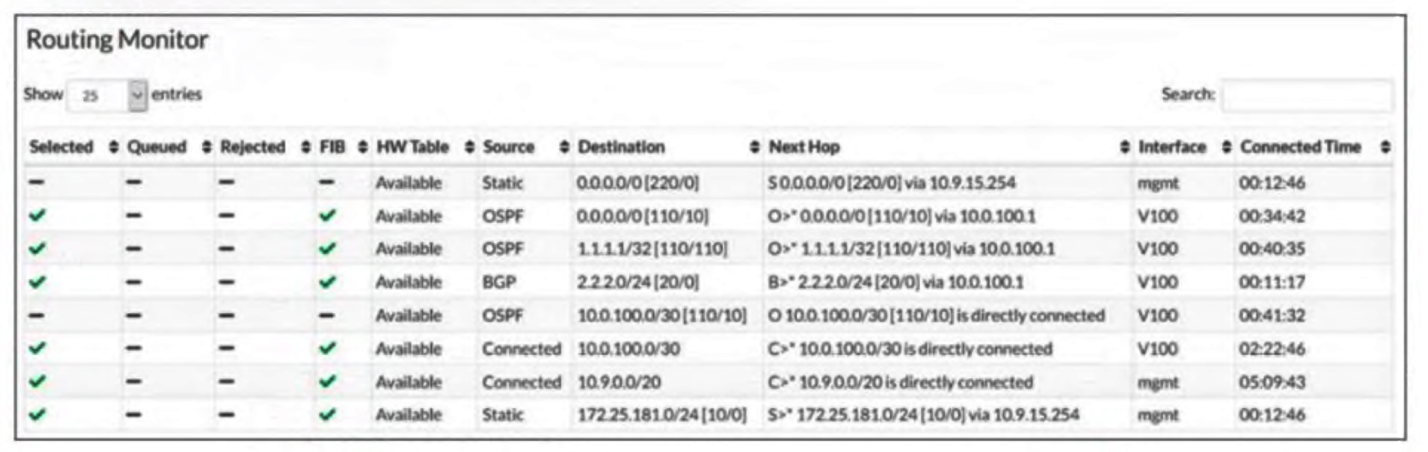
AThe OSPF route has a higher metric, making it less preferred than the static route.
BThe interface V100 for the OSPF route is down, preventing its installation.
CThe OSPF route with a lower administrative distance is preferred over the static route.
DThe two routes have identical destination prefixes, causing a conflict where only one is selected.
Question #2Part 1Enterprise Networking

What occurs if a FortiSwitch cannot discover either FortiEdge Cloud or a FortiGate with FortiLink?

AIt switches to FortiLink mode by default.
BIt remains in local management mode.
CIt requires manual reimaging.
DIt disables auto-network.
Question #3Part 1Network Security

You enable Dynamic Host Configuration Protocol (DHCP) snooping on a VLAN and set a FortiSwitch port as trusted for DHCP snooping. What further action is required to configure that port as trusted for Dynamic ARP Inspection (DAI)?

AEnable IP Source Guard (IPSG) on the port.
BManually set the port as trusted for DAI through the CLI.
CDAI implicitly trusts the port.
DEnable static MAC learning on the port.
Question #4Part 1Network Security

What is a key advantage of using a sniffer profile on FortiSwitch rather than the sniffer command?

AIt allows packet capture on all switch ports without limitations.
BIt eliminates the need to use access control lists (ACLs) or port mirroring for analysis.
CIt automatically filters irrelevant traffic types.
DIt automatically decrypts SSL/TLS traffic for full packet inspection.
Question #5Part 1Enterprise Networking

You are designing a FortiSwitch backbone in which each FortiSwitch device must connect to every other FortiSwitch to provide maximum redundancy. To preserve connectivity while avoiding loops, which protocol or feature must be configured on the switches?

ASpanning Tree Protocol (STP)
BMultichassis link aggregation group (MCLAG)
CFull mesh high availability (HA)
DLink aggregation group (LAG)
Question #6Part 1Enterprise NetworkingSelect 2

Refer to the exhibits. ![Question Image](https://cdn.examcademy.com/images/questions/1784318395048-p2v0y9bx.png) ![Question Image](https://cdn.examcademy.com/images/questions/1784318397286-caev4h7x.png) You are reviewing a FortiSwitch configuration in which port1 and port2 connect to a switched network. Loop guard is enabled on port1. The CLI output indicates that port1 has a triggered status because of loop guard. Which two conditions could have caused this shutdown? (Choose two.)

AA loop guard frame sent from port1 is received on port2.
BA loop guard frame sent from port1 is received back on port1.
CLoop guard is triggered because the port detected excessive traffic.
DLoop guard is triggered because port2 did not send any bridge protocol data units (BPDU).
Question #7Part 1Network Security

Which two statements about the FortiLink authorization process are correct?

AA FortiLink frame is sent by FortiGate to FortiSwitch to complete the authorization.
BFortiLink authorization sets the FortiSwitch management mode to FortiLink.
CFortiSwitch requires a reboot to complete the authorization process.
DFortiLink authorization permanently erases the existing configuration of the FortiSwitch.
Question #8Part 1Network Security

When Dynamic Host Configuration Protocol (DHCP) snooping is enabled on a FortiSwitch VLAN, which two statements are correct?

ADHCP replies are accepted only on trusted ports.
BDHCP snooping blocks all unicast traffic.
COption 82 can be inserted into DHCP requests.
DDHCP requests are dropped if sent from trusted ports.
Question #9Part 1Network Security

You are designing a multi-tenant network with FortiSwitch devices operating in standalone mode. Security is a priority: every tenant’s servers must be fully isolated from each other and from every other server on the network to prevent lateral communication. However, all servers must be able to access the shared FortiGate firewall for internet connectivity. Which private VLAN (PVLAN) configuration type should you use to meet these security requirements?

APrimary VLAN
BCommunity VLAN
CIsolated VLAN
DStandalone VLAN
Question #10Part 1Enterprise NetworkingSelect 2

Refer to the exhibit. ![Question Image](https://cdn.examcademy.com/images/questions/1784318382198-7mm1ntzi.png) Port24 is the sole uplink port connected to the network from which access to FortiSwitch management services is required. However, FortiSwitch cannot be reached through its management interface at IP address `10.0.13.3`. Based on the configuration displayed in the exhibit, which two actions should you take to resolve the issue and access FortiSwitch? (Choose two.)

AAdd VLAN 4094 to the allowed VLANs on port24.
BChange the native VLAN on port24 to VLAN 4094.
CRemove VLAN 200 from the allowed VLANs on port24.
DChange the management IP address to use the VLAN 100 subnet.
Question #11Part 1Enterprise Networking

Refer to the exhibits. Topology view — ![Question Image](https://cdn.examcademy.com/images/questions/1784316709732-m1pxw11l.png) Core-1 CLI output — ![Question Image](https://cdn.examcademy.com/images/questions/1784316712334-szbp43px.png) Core-2 CLI output — ![Question Image](https://cdn.examcademy.com/images/questions/1784316715094-xarl4fwz.png) An administrator deployed two FortiSwitch devices, Core-1 and Core-2, as multichassis link aggregation group (MCLAG) peers. The switches connect to FortiGate for FortiLink and to an access switch (Access-1) through an inter-switch link (ISL). After configuration, the administrator observes that both Core-1 and Core-2 claim to be the root bridge in the Multiple Spanning Tree Protocol (MSTP) topology. What accounts for this behavior?

AFortiGate participates in MSTP and causes both switches to assume the root bridge role.
BThe ISL was not configured correctly, leading to MSTP inconsistency.
CBoth switches share the same bridge ID because MCLAG treats them as one logical switch.
DMCLAG automatically disables STP on all peer switches.
Question #12Part 1Network Security

On supported FortiSwitch models, which access control list (ACL) stage is recommended to apply actions before the switch carries out any Layer 2 or Layer 3 processing?

APrelookup
BIngress
CEgress
DForwarding
Question #13Part 1Enterprise NetworkingSelect 2

Refer to the exhibit. ![Question Image](https://cdn.examcademy.com/images/questions/1784318383357-76iur219.png) How does Spanning Tree Protocol (STP) view MC-LAG and LAG when they are configured according to the physical topology shown? (Choose two.)

ASTP treats Switch 3 and Switch 4 uplinks as single interfaces.
BSTP see Switch 3 and switch 4 as one MCLAG switch client.
CSTP sees Switch 1, Switch 2, and Switch 3 as one MCLAG peer group.
DSTP see Switch 1 and Switch 2 as a single switch.
Question #14Part 1Enterprise Networking

Which statement most accurately describes a benefit of using MAC-, IP address-, or protocol-based VLAN assignments on FortiSwitch?

AIt disables 802.1X authentication while preserving user access control.
BIt requires devices to authenticate through a RADIUS server before VLAN tagging.
CIt assigns ports to VLANs regardless of device type or traffic.
DIt offers dynamic segmentation benefits similar to 802.1X authentication.
Question #15Part 1Enterprise NetworkingSelect 2

Refer to the exhibit. Debug output: ![Question Image](https://cdn.examcademy.com/images/questions/1784316703522-pw0erprj.png) Which two statements best describe the FortiLink debug output displayed in the exhibit? (Choose two.)

AFortiSwitch is in a waiting state to join the stack group on FortiGate.
BFortiSwitch is sending FortiLink heartbeats to FortiGate.
CFortiSwitch is discovered and authorized by FortiGate.
DFortiSwitch is sending LLDP-MED inventory management updates to FortiGate.
Question #16Part 1Enterprise Networking

Which LLDP-MED type-length-values (TLV) does FortiSwitch obtain from endpoints to track network devices and identify their characteristics?

AAsset management
BInventory management
CCapabilities
DNetwork policy
Question #17Part 1Enterprise Networking

Refer to the exhibit. What information does FortiGate use to create the port details in the FortiSwitch Faceplates view?

AThe FortiSwitch model
BThe Cisco Discovery Protocol (CDP) advertisements from FortiSwitch
CThe LLDP advertisements received from the FortiSwitch
DThe FortiLink discovery frames sent by FortiSwitch
Question #18Part 1Enterprise NetworkingSelect 2

You are configuring VLANs on a FortiSwitch device that is managed by FortiGate. Which two statements correctly describe VLAN-assignment requirements and behavior on FortiSwitch ports? (Choose two.)

AUntagged defines the list of VLANs that are allowed on the port for both ingress and egress traffic.
BUntagged VLAN applies to egress traffic only.
CYou can assign only one native VLAN on a port.
DVLAN assignments must be configured directly on the FortiSwitch.
Question #19Part 1Enterprise Networking

Refer to the exhibit. A debug capture of the `fortilinkd` process on FortiGate is displayed. ![Question Image](https://cdn.examcademy.com/images/questions/1784316697791-eak3hcxe.png) A managed FortiSwitch sends a periodic heartbeat message, and the corresponding FortiGate acknowledgments are shown. What does this behavior indicate?

AThe FortiLink connection between FortiGate and FortiSwitch is healthy and active.
BFortiGate is unable to establish a FortiLink session with FortiSwitch.
CForitSwitch is expecting an authorization from FortiGate.
DFortiSwitch has not been authorized yet.
Question #20Part 1Network Security

Refer to the exhibits. ![Question Image](https://cdn.examcademy.com/images/questions/1784318390683-9z207lb8.png) ![Question Image](https://cdn.examcademy.com/images/questions/1784318392944-vvncit4z.png) ![Question Image](https://cdn.examcademy.com/images/questions/1784318395469-rrd8y9wo.png) You enable Dynamic Host Configuration Protocol (DHCP) snooping on the **Student** VLAN. The Linux-Client VM sends DHCP requests, and `tcpdump` verifies the broadcasts. However, the Linux-Server VM, acting as the DHCP server, receives no DHCP traffic. What is the most likely reason this intra-VLAN traffic is being blocked?

APort4 is not configured as a trusted port.
BPort1 is configured as an untrusted port.
CThe DHCP requests are being sent on the wrong VLAN.
DThe Student VLAN must be configured as an allowed VLAN on port1.
Question #21Part 1Network Security

Refer to the exhibits. Network topology — ![Question Image](https://cdn.examcademy.com/images/questions/1784316695998-00o8c9yo.png) DHCP snooping database — ![Question Image](https://cdn.examcademy.com/images/questions/1784316699138-vrf3o47e.png) All three FortiSwitch-connected ports are configured in VLAN 10. FortiGate operates as the Dynamic Host Configuration Protocol (DHCP) server and is connected to a DHCP-snooping trusted trunk port. PC1 and PC2 connect to ports configured as untrusted for DAI, and no static bindings are configured in the IP source guard (IPSG) database. PC2 is compromised and tries to spoof the FortiGate IP address by transmitting forged Address Resolution Protocol (ARP) replies using its own MAC address. What will FortiSwitch do with the ARP packets from PC2?

AForward the ARP replies because there are no IPSG bindings blocking them.
BAccept the ARP replies because the VLAN has DAI enabled and FortiGate is a trusted DHCP server.
CForward the ARP replies to all VLAN 10 ports because DAI is only active on trusted ports.
DDrop the ARP replies because they fail DAI validation against the DHCP snooping database.
Question #22Part 1Enterprise Networking

How does FortiSwitch choose the route for traffic passing through its interfaces?

AHardware-based routing on FortiSwitch is handled by the CPU.
BASIC hardware routing can handle only dynamic routing, if supported.
CFortiSwitch looks up the hardware routing table and then the forwarding information base (FIB).
DFortiSwitch forwards all traffic to FortiGate for routing decisions.
Question #23Part 1Network SecuritySelect 2

Which two statements about 802.1X authentication on FortiSwitch ports are correct? (Choose two.)

AIn port-based 802.1x, all hosts behind an authenticated port are allowed access after a successful authentication.
BA port policy is used to apply 802.1x authentication on a FortiSwitch interface.
C802.1X authentication can be applied only to trunk ports and not access ports.
DAll devices connecting to FortiSwitch must support 802.1X authentication.
Question #24Part 1Enterprise Networking

What happens to the existing standalone configuration when you change a FortiSwitch management mode from standalone to managed?

AFortiSwitch registers to FortiSwitch Cloud to save a copy before managing with FortiGate.
BFortiSwitch merges the existing standalone configuration with the default FortiLink configuration.
CFortiSwitch saves the standalone configuration and changes to the default FortiLink configuration.
DFortiGate automatically saves the existing FortiSwitch configuration during the FortiLink management process.
Question #25Part 1Enterprise Networking

You must mirror traffic from a source port on Switch A to a monitoring device on Switch C. To do this, you are configuring Remote Switched PortAnalyzer (RSPAN). Because of the nature of RSPAN, what is the recommended practice when configuring it?

AUse a dedicated VLAN assigned only to motoring devices.
BUse the RSPAN VLAN as a native VLAN on all trunk ports.
CUse the same VLAN already configured for regular data traffic.
DUse a dynamic VLAN that includes all switch ports.
Question #26Part 1Network Security

Which three actions can a FortiSwitch access control list (ACL) validly apply to traffic that matches it?

AAssign the VLAN ID
BQoS
CTraffic processing
DQuarantine devices
ESet outer VLAN tags
Question #27Part 1Enterprise NetworkingSelect 2

An administrator needs to deploy managed FortiSwitch devices at a remote location where multiple VLANs are required to segment devices. No Layer 3 switch or router exists at the site, and the only WAN connection is an ISP-provided router connected to the public internet. Which two components are required to enable VLAN segmentation across this remote site? *(Choose two.)*

AFortiGate and FortiSwitch configured with VXLAN to tunnel VLANs over the WAN
BA layer 3 router at the remote location to handle inter-VLAN routing
CA FortiSwitch model that supports VXLAN hardware acceleration
DFortiSwitch and FortiGate devices configured with IPsec interfaces
EFortiGate with a layer 3 interface to terminate the VXLAN overlay
Question #28Part 1Network Security

You are preparing to deploy FortiSwitch devices on your network. Your objective is to simplify management and ensure integration with the Security Fabric. Which deployment method should you select?

AUse the FortiSwitch-Manager device for centralized management.
BManage FortiSwitch from FortiManager for large-scale enterprise deployments.
CManage FortiSwitch on FortiGate using FortiLink.
DUse FortiEdge Cloud for centralized management with advanced analytics.
Question #29Part 1Network Security

Refer to the exhibit. ![Question Image](https://cdn.examcademy.com/images/questions/1784316702464-vrua2rpj.png) The security port policy is configured as shown. What happens when a device connected to the port does not support 802.1X?

AThe device is blocked from accessing the network.
BThe device is placed into the onboarding VLAN.
CThe device is placed into the quarantine VLAN.
DThe device is assigned to the default management VLAN.
Question #30Part 1Network Security

Refer to the exhibit. ![Question Image](https://cdn.examcademy.com/images/questions/1784318389771-jbjd8am1.png) A FortiSwitch 802.1X port-security configuration is displayed. A user connects a laptop to the port and tries to authenticate with 802.1X, but enters incorrect credentials several times. What will happen to the device?

AThe device will be placed into the VLAN onboarding.
BThe device will be assigned to the default management VLAN.
CThe port will shut down for security reasons.
DThe device will be placed into the VLAN quarantine.
Question #31Part 1Enterprise Networking

You are deploying a new FortiSwitch device at a branch office and want FortiGate to automatically detect and manage it. Which FortiSwitch feature provides automatic detection during deployment?

AAuto-discovery
BZero-touch deployment
CLink Layer Discovery Protocol (LLDP)
DFortilink heartbeat
Question #32Part 1Enterprise Networking

Refer to the exhibit shown. Topology view - ![Question Image](https://cdn.examcademy.com/images/questions/1784316696829-h3apzz80.png) You have just connected three FortiSwitch devices: Core-1, Core-2, and Access-1. Core-1 and Core-2 each connect to Access-1 for redundancy. All switches are managed by FortiGate, which uses port4 as the FortiLink interface. After enabling the uplink ports on Core-2, you observe that port3 on Access-1 enters the Discarding STP state. What is the most likely cause of this behavior?

ABridge Protocol Data Unit (BPDU) Guard is enabled, which shuts down the port after it receives BPDUs.
BAccess-1 is not authorized by FortiGate.
CCore-2 has the lowest bridge priority.
DFortiGate is not running Spanning Tree Protocol (STP) on the FortiLink interface.

📢 Unlock Full Access to Success!

"The content displayed here is a promotional preview and contains only 50% of the actual exam database. To access the complete set of updated questions, please upgrade to the Full Version."

👉 Click the button and follow the instructions to secure your full access immediately!