Welcome to awslagi.com – Sharing AWS, Google Cloud, Microsoft Azure IT Exams. It's free for all!

FCSS-NST-SE-7-6: Fortinet NSE 6 - Network Security 7.6 Support Engineer

Master the Fortinet Fortinet NSE 6 - Network Security 7.6 Support Engineer (FCSS-NST-SE-7-6) certification exam with 35 realistic practice questions covering System troubleshooting, Routing, VPN, Authentication.

4.8★★★★★(245 ratings)
13,517 studentsIntermediate
Prepare for the Fortinet Fortinet NSE 6 - Network Security 7.6 Support Engineer (FCSS-NST-SE-7-6) certification with scenario-based practice questions modeled on real exam objectives. You will build practical confidence across key domains including System troubleshooting, Routing, VPN, Authentication. Each question includes structured answer options and hint answers to help you identify knowledge gaps quickly, reinforce core Fortinet concepts, and pass the FCSS-NST-SE-7-6 exam on your first attempt.

What you'll learn

  • System troubleshooting
  • Routing
  • VPN
  • Authentication
  • Security profiles

FCSS-NST-SE-7-6

Lectures1
Questions35
Duration30 week
Students13,517

$20.00

Full Free Question Bank (35 Questions)

FCSS-NST-SE-7-6: Fortinet NSE 6 - Network Security 7.6 Support Engineer (FCSS-NST-SE-7-6) Practice Questions & Verified Answers

Click any option to test your knowledge, or reveal the verified answer and detailed explanation below each question.

Question #1Part 1System troubleshootingSelect 3

Refer to the exhibit. ![Question Image](https://cdn.examcademy.com/images/questions/1783914592631-354bcqmh.png) Which three items of information are provided by the `diagnose sys top` command? (Choose three.)
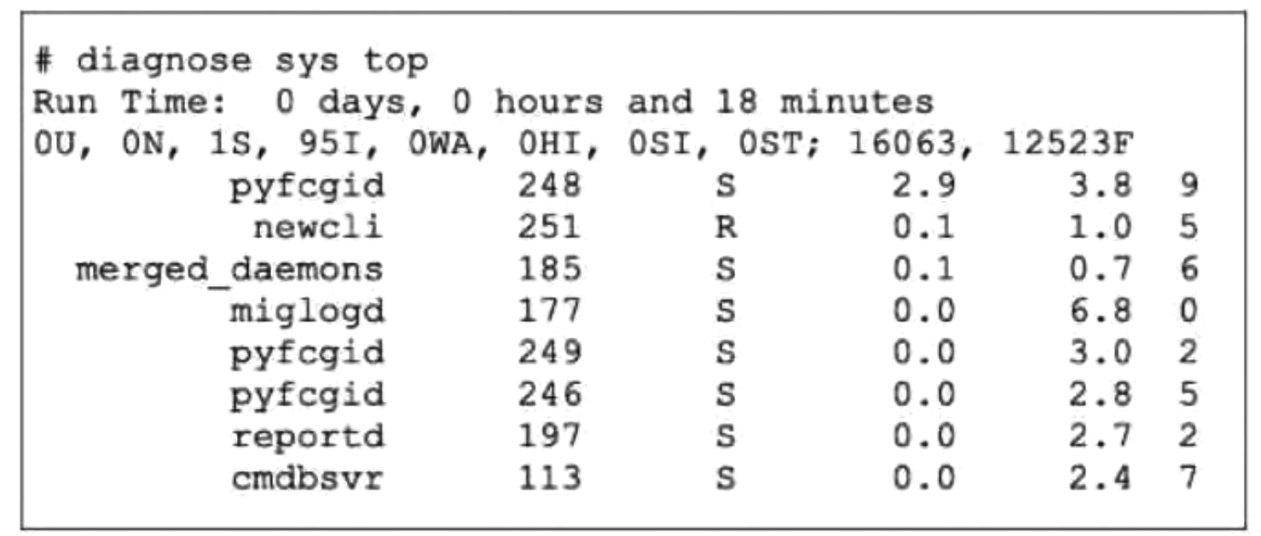
AThe miglogd daemon is running on CPU core ID 0.
BThe cmdbsvr process is occupying 2.4% of the total user memory space.
CThe diagnose sys top command has been running for 18 minutes.
DIf the newcli daemon continues to be in the R state, it will need to be manually restarted.
EThe miglogd daemon would be on top of the list, if the administrator pressed m on the keyboard.
Question #2Part 1System troubleshootingSelect 2

Refer to the exhibit. Partial output from a diagnose command ![Question Image](https://cdn.examcademy.com/images/questions/1783914592360-bdwdh5qk.png) A partial output of a diagnose command is displayed. Which two conclusions can you draw from the output in the exhibit? (Choose two.)

AFortiGate will drop the expected traffic if it does not arrive within 23 seconds.
BThe packets that belong to this session are checked against firewall policy ID 25.
CThe TCP session is not established.
DThis is a pinhole session to allow traffic for a TCP protocol that dynamically assigns TCP ports.
Question #3Part 1Routing

Which two protocol states show that traffic is bidirectional?

Aproto_state=05 for a TCP session.
Bproto_state=01 for a TCP session.
Cproto_state=01 for a UDP session.
Dproto_state=00 for an ICMP session.
Question #4Part 1RoutingSelect 2

Refer to the exhibits. Exhibit 1 – ![Question Image](https://cdn.examcademy.com/images/questions/1783915417504-as041z6c.png) Exhibit 2 – ![Question Image](https://cdn.examcademy.com/images/questions/1783915421425-rp2owoip.png) The FortiGate configuration and partial Internet-session information for a user on the internal network are displayed. An administrator wants to test session failover between the two service-provider connections. Which two changes must the administrator make to force this existing session to immediately begin using the other interface? (Choose two.)

AModify the distance of the port1 route to 1.
BChange the priority of the port1 static route to 11.
CConfigure set snat-route-change enable.
DChange the priority of the port2 static route to 5.
Question #5Part 1RoutingSelect 2

Refer to the exhibits. ![Question Image](https://cdn.examcademy.com/images/questions/1783916414025-vpa3gvuu.png) An administrator is trying to advertise the network configured on port3, but FGT-A is not receiving the prefix. Which two actions can the administrator perform to resolve this issue? (Choose two.)

AModify the prefix using the network command and specify le 16 to include the 172.16.54.0/24 subnet.
BModify the prefix using the network command from 172.16.0.0/16 to 172.16.54.0/24.
CUse the set network-import-check disable command.
DRestart BGP using a soft reset to force both peers to exchange their complete BGP routing tables.
Question #6Part 1VPN

Refer to the exhibit. An IPsec VPN tunnel is dropping, as indicated in the debug output. Based on the debug output, what could be causing the tunnel to go down?

AThe local FortiGate is dropping the incoming IKE packets from the peer.
BThe NAT-T negotiation was unsuccessful.
CDead Peer Detection is not receiving its acknowledge packet.
DThere is no active route to the remote peer.
Question #7Part 1VPNSelect 2

Refer to the exhibit. ![Question Image](https://cdn.examcademy.com/images/questions/1783916418713-aiqvpx6b.png) The output from the `diagnose vpn tunnel list` command is displayed. Which two statements correctly describe the tunnel's status? (Choose two.)

APhase 1 is down.
BBoth Phase 1 and Phase 2 were negotiated successfully.
CPhase 2 is down.
DThere is currently no traffic traversing the tunnel.
Question #8Part 1System troubleshooting

Refer to the exhibit. Partial FortiOS kernel-slab output is displayed. ![Question Image](https://cdn.examcademy.com/images/questions/1783912421594-96z6kikb.png) Which statement about the total slab size is correct?

AThe total slab size of the ip6_session slab is 1472 kB and is associated with the kernel.
BThe total slab size of the ip_session slab is 14080 kB and is associated with the user space.
CThe total slab size of the UDPv6 slab is 14080 kB and is associated with the user space.
DThe total slab size of the tcp_session slab is 7500 kB and is associated with the kernel.
Question #9Part 1System troubleshootingSelect 2

Which two troubleshooting steps should you take if you experience intermittent web-filter behavior? (Choose two.)

ACheck that the correct port is mapped to HTTP in the Protocol Options.
BCheck that the communication between FortiGate and FortiGuard is stable.
CCheck that the inspection mode configured for the web filter profile matches that of the firewall policy where it is applied.
DCheck that FortiGate is not entering conserve mode.
Question #10Part 1AuthenticationSelect 2

Refer to the exhibit. A partial output from the real-time LDAP debug is displayed. ![Question Image](https://cdn.examcademy.com/images/questions/1783916871626-auownefn.png) Which two actions can the administrator perform to resolve this problem? (Choose two.)

AEnsure the account is active.
BEnsure the user is providing the correct user credentials.
CEnsure the user is a member of at least one AD group to ensure that step 4 of the LDAP authentication process is successful.
DEnsure the user logs in using ‘John Smith’ not ‘jsmith’.
Question #11Part 1VPN

Refer to the exhibit. Debug output: A partial IKE real-time debug output is displayed. The administrator cannot access the remote gateway. Based on the debug output, which two conclusions can be drawn?

AThere is a Diffie-Hellman group mismatch.
BThis is a phase1 negotiation.
CThe remote peer is the initiating peer.
DThis is a phase2 negotiation.
Question #12Part 1Routing

Refer to the exhibit. The output from a BGP debug command is displayed. ![Question Image](https://cdn.examcademy.com/images/questions/1783916419561-e35tgytz.png) What is the most likely reason the local FortiGate is not receiving any prefixes from its neighbors?

AThe RIB-OUT configuration for router 10.127.0.75 prevents any route advertisement lo the local router.
BThe router 100.64.3.1 is waiting for the OPEN message from the local router.
CThe local router is waiting for the keepalive message from the router 10.125.0.60.
DNone of the three neighbors has successfully established the TCP three-way handshake with the local router.
Question #13Part 1System troubleshootingSelect 2

Refer to the exhibit. ![Question Image](https://cdn.examcademy.com/images/questions/1783916407250-9x7a6hin.png) A partial output from `diagnose npu np6 port-list` on a FortiGate 2000E is displayed. An administrator cannot analyze traffic passing between port1 and port17 with the `diagnose sniffer` command. Which two commands enable the administrator to view the traffic? (Choose two.)

Adiagnose npu np6 port-list disable 5 17
Bdiagnose npu np6 fastpath disable 1
Cconfig system npuset fastpath disableend
Dconfig firewall policyedit 5set auto-asic-offload disableendnextedit 17set auto-asic-offload disableend
Question #14Part 1Security profiles

Which two actions does FortiGate perform after an administrator enables the auxiliary-session setting?

AFortiGates creates a new auxiliary session for each packet it receives.
BFortiGate only offloads auxiliary sessions.
CFortiGate creates two sessions in case of a routing change.
DFortiGate accelerates all ECMP traffic to the NP6 processor.
Question #15Part 1Security profilesSelect 3

While investigating a FortiGate web-filtering problem, users state that they cannot reach any websites, although those sites are not explicitly denied by any web-filter profiles applied to firewall policies. What are the three most likely causes of this behavior? (Choose three.)

AThe webfilter-force-off setting has been enabled under config system fortiguard.
BThe FortiGuard Web Filtering license has expired, causing FortiGate to apply the default block action.
CThe SSL/TLS deep inspection was configured but the browsers do not have the FortiGate certificate installed.
DThe web filter cache has been cleared causing all websites to take longer to be rated.
EThe DNS server is unreachable, preventing URL resolution.
Question #16Part 1System troubleshootingSelect 2

Refer to the exhibit. Debug output – ![Question Image](https://cdn.examcademy.com/images/questions/1783912670087-da1i80jy.png) Which two statements regarding FortiGate behavior for this session are correct? (Choose two.)

AFortiGate either initiated the session or the session terminates at FortiGate.
BFortiGate redirected the client to the captive portal to authenticate so that a correct policy match could be made.
CFortiGate forwarded this session without any inspection.
DFortiGate is performing a security profile inspection using the CPU.
Question #17Part 1RoutingSelect 2

Refer to the exhibit. ![Question Image](https://cdn.examcademy.com/images/questions/1783916420025-k8fy7rsm.png) The exhibit displays the port1 interface configuration on FortiGate and partial session details for ICMP traffic. Which two events occur to the session information when a routing change affects this session? (Choose two.)

AThe session information will not change even when the active route has been removed from the routing table.
BThe session information will not change unless the current route has been removed from the routing table.
CThe session will be flagged as dirty but no route lookups will be performed.
DThis session will be unaffected by routing changes. The routing changes will apply only to new sessions.
Question #18Part 1System troubleshootingSelect 2

Refer to the exhibit. Partial output from the `diagnose hardware sysinfo memory` command is displayed. ![Question Image](https://cdn.examcademy.com/images/questions/1783916293090-67mdy6ti.png) Which two memory allocations can help troubleshoot a possible resource issue? (Choose two.)

AThe user space, which has 708880 kB of physical memory that is not used by the system.
BThe 98908 kB of memory that will never be used.
CThe I/O cache, which has 641364 kB of memory allocated to it.
DThe unused cache page, which is represented by the value indicated next to the Inactive heading.
Question #19Part 1System troubleshooting

Refer to the exhibit. ![Question Image](https://cdn.examcademy.com/images/questions/1783915419522-pgycdi35.png) FortiGate is experiencing continuous high CPU utilization. During a maintenance window, the CLI command `diagnose sys top` shows the output in the exhibit. The CLI command `diagnose test application ipsmonitor 5` was executed, but CPU use by the `ipsengine` daemon did not decrease. Which immediate action can be taken to reduce CPU usage effectively?

AReduce the number of IPS signatures enabled on the active IPS profiles.
BBypass all IPS engines.
CExecute diagnose test application ipsmonitor 2 instead.
DDisable IPS on all firewall policies.
Question #20Part 1System troubleshootingSelect 2

Refer to the exhibit. The displayed output is from the `diagnose automation test` command. ![Question Image](https://cdn.examcademy.com/images/questions/1783916407442-kenitcsh.png) Which two observations can be made from this output? (Choose two.)

AThe test was unsuccessful.
BThe automation stitch test is not being logged.
CA high availability (HA) failover occurred.
DThe configuration was backed up.
Question #21Part 1Authentication

Refer to the exhibits. Network topology — ![Question Image](https://cdn.examcademy.com/images/questions/1783916861267-mxh1kvj8.png) OSPF database — ![Question Image](https://cdn.examcademy.com/images/questions/1783916865114-nwo1jkai.png) FGT-1 is an area border router (ABR) with interfaces in OSPF areas 0.0.0.0 and 0.0.0.5. FGT-3 operates as an autonomous system border router (ASBR), importing static routes into OSPF. FGT-2 is an internal router, with all of its interfaces in area 0.0.0.5. FGT-1 is receiving every route advertised by FGT-2; however, FGT-3 is not receiving any routes advertised by FGT-1. What is the most likely cause?

AArea 0.0.0.5 is configured not to propagate type 5 LSAs.
BFGT-2 is configured with a distribution list to block all advertised routes from FGT-3.
CFGT-3 and FGT-2 have not formed an OSPF adjacency yet.
DIP protocol 89 is blocked between FGT-1 and FGT-3.
Question #22Part 1Routing

Refer to the exhibit. The output of the `get router info bgp summary` command is displayed. ![Question Image](https://cdn.examcademy.com/images/questions/1783916862216-wbis4ee1.png) Which statement about the adjacencies between the local router and its neighbors is correct?

AThe local router and neighbor 100.64.2.254 are unable to establish adjacency because AS 100 is already used by neighbor 100.64.1.254.
BThe local router and neighbor 100.64.2.254 are unable to establish adjacency until the adjacency with neighbor 100.64.1.254 ceases.
CThe local router and neighbor 100.64.2.254 are unable to establish adjacency because the TCP session could not be established.
DThe local router and neighbor 100.64.1.254 established adjacency because the priority of 100.64.1.254 is higher than that of 100.64.2.254.
Question #23Part 1RoutingSelect 2

Refer to the exhibits. ![Question Image](https://cdn.examcademy.com/images/questions/1783916292333-noonfabg.png) An OSPF peer advertises route 172.16.52.0/24. The local FortiGate has an inbound distribution list configured to allow the 172.16.0.0/16 network into its routing table. However, the 172.16.52.0/24 subnet is not visible in the FIB. Which two actions can the local FortiGate administrator take to ensure the advertised 172.16.52.0/24 subnet is injected into the routing table? (Choose two.)

AChange the le value to 16.
BAdd another entry to the prefix list to specifically allow the 172.16.52.0/24 network.
CModify the default prefix-list behavior from implicit deny to implicit allow.
DChange the ge value to 17.
Question #24Part 1Security profilesSelect 2

Refer to the exhibit. The partial output of a session-table entry is displayed. ![Question Image](https://cdn.examcademy.com/images/questions/1783916855723-yrn0hgaj.png) Which two statements regarding the output displayed in the exhibit are correct? (Choose two.)

AThe traffic is tagged for a VLAN interface.
BNP7 is handling offloading of this session.
CThe session has been offloaded.
DThe traffic matches Policy ID 1.
Question #25Part 1System troubleshooting

Refer to the exhibit. The partial output from the `diagnose sys session stat` command is displayed. ![Question Image](https://cdn.examcademy.com/images/questions/1783912420931-8do438v6.png) Which statement about the output displayed in the exhibit is correct?

A27 sessions have expired but are still in the session table in case any out-of-order packets arrive.
B562 TCP sessions have their proto_state set to 01 if there is no inspection.
CThere have been 131072 recorded ephemeral sessions but there are no current ones.
D113 sessions have been dropped because of memory page exhaustion.
Question #26Part 1System troubleshootingSelect 2

Refer to the exhibit. Partial output from the `diagnose sys session stat` command is displayed. ![Question Image](https://cdn.examcademy.com/images/questions/1783915930737-o0m13fyg.png) An administrator has observed unusual behavior from FortiGate. Sessions appear to be removed randomly. Which two reasons could account for this? (Choose two.)

AFortiGate is flushing sessions because of high memory usage.
BFortiGate is deleting sessions because the kernel cannot allocate more memory pages.
CFortiGate is not accepting sessions because the device has been down 16 out of 120 seconds.
DFortiGate is dropping all TCP sessions with incomplete three-way handshakes.
Question #27Part 1RoutingSelect 3

Refer to the exhibit. Routing table: ![Question Image](https://cdn.examcademy.com/images/questions/1783916868197-rsht12do.png) The routing-table information is displayed. Assuming the default configuration, which three statements about the FortiGate RPF check are correct? (Choose three.)

AUser B: Fail. There is no route to 95.56.234.24 using wan2 in the routing table.
BUser A: Pass. The default static route through wan1 passes the RPF check regardless of the source IP address.
CUser C: Pass. FortiGate will forward all incoming packets from User C using the default static route.
DUser C: Fail. There is no route to 10.0.4.63 using port1 in the routing table.
EUser B: Pass. FortiGate will use asymmetric routing using wan1 to reply to traffic for 95.56.234.24.
Question #28Part 1VPNSelect 2

Refer to the exhibits. ![Question Image](https://cdn.examcademy.com/images/questions/1783914607992-2zk0pzw8.png) Partial configurations for two VPNs on a FortiGate are displayed. An administrator configured two VPNs for two separate user groups. Users in the `Users-2` group cannot connect to the VPN. After running a diagnostic command, the administrator finds that FortiGate is not matching the `user-2` VPN for members of the `Users-2` group. Which two changes must the administrator make to resolve the issue? (Choose two.)

AChange to aggressive mode on both VPNs.
BEnable XAuth on both VPNs.
CSet up specific peer IDs on both VPNs.
DUse different pre-shared keys on both VPNs.
Question #29Part 1VPNSelect 2

A VPN tunnel is established. To monitor traffic flow, an administrator runs the following CLI commands through an SSH session on a FortiGate: ```text # diagnose debug enable # diagnose sniffer packet any ’udp and port 500’ 4 ``` However, the sniffer produces no output. Assuming default configuration values, which two possible reasons explain the lack of output? (Choose two.) # diagnose debug enable # diagnose sniffer packet any ’udp and port 500’ 4

AThe sniffer output will be ignored because running diagnose debug enable shows only application real-time debugs.
BNAT Traversal is enabled.
CThe sniffer must be restricted to the remote peer IP address.
DThe filter should be modified to also capture packets for TCP port 443 or TCP port 4500.
Question #30Part 1Authentication

During the SAML negotiation process, in which section does the identity provider (IdP) supply the SAML attributes used during authentication to the service provider (SP)?

AAssertion dump
BBindings HTTP post
CAuthentication request
DAuthentication response
Question #31Part 1Routing

Refer to the exhibit. Which route will traffic use to reach the 100.65.0.0/24 network, considering that all routes are configured with the same distance?

AThe static route
BThe OSPF route
CThe policy route
DThe BGP route
Question #32Part 1System troubleshootingSelect 2

Refer to the exhibit. The collector agent log output is displayed. ![Question Image](https://cdn.examcademy.com/images/questions/1783916864866-kh2oimjv.png) The collector agent reports a workstation status of “Not Verified”. What are two common causes of this message? (Choose two.)

ADNS cannot resolve the workstation name.
BTraffic to port 139 and 445 is blocked.
CThe workstation remote registry is not running.
DThe workstation has come out of hibernate mode.
Question #33Part 1System troubleshooting

When FortiGate enters conserve mode due to memory pressure, which action can it take to conserve memory?

AFortiGate begins dropping all new sessions to protect system resources.
BFortiGate reduces or stops non-essential processes like logging and antivirus scanning.
CFortiGate switches to a less memory-intensive inspection mode, such as flow-based inspection.
DFortiGate automatically reboots to clear memory and restore full operation.
Question #34Part 1System troubleshootingSelect 2

Refer to the following exhibit. ![Question Image](https://cdn.examcademy.com/images/questions/1783916421022-mdqs9knr.png) The exhibit displays the output of a session. Which two statements are correct? (Choose two.)

AThe session was initiated from an authenticated user.
BThe TCP session has been successfully established.
CThe gateway to the destination is 10.1.10.1.
DThe session did not match a firewall policy.
Question #35Part 1VPN

Refer to the exhibit. Debug output – The output from thediagnose vpn tunnel listcommand is displayed. When reviewing this debug command, what is the present status of the traffic flowing through the tunnel?

ANP6 is handling the offloading.
BThe inbound IPsec SA was copied to the NPU.
CThe outbound IPsec SA was copied to the NPU.
DThe inbound and outbound IPsec SAs were copied to the NPU.

📢 Unlock Full Access to Success!

"The content displayed here is a promotional preview and contains only 50% of the actual exam database. To access the complete set of updated questions, please upgrade to the Full Version."

👉 Click the button and follow the instructions to secure your full access immediately!