Welcome to awslagi.com – Sharing AWS, Google Cloud, Microsoft Azure IT Exams. It's free for all!

FCSS-EFW-AD-7-6: Fortinet NSE 7 - Enterprise Firewall 7.6 Administrator

Master the Fortinet Fortinet NSE 7 - Enterprise Firewall 7.6 Administrator (FCSS-EFW-AD-7-6) certification exam with 33 realistic practice questions covering Routing, Security profiles, VPN, System configuration.

4.8★★★★★(307 ratings)
12,259 studentsIntermediate
Prepare for the Fortinet Fortinet NSE 7 - Enterprise Firewall 7.6 Administrator (FCSS-EFW-AD-7-6) certification with scenario-based practice questions modeled on real exam objectives. You will build practical confidence across key domains including Routing, Security profiles, VPN, System configuration. Each question includes structured answer options and hint answers to help you identify knowledge gaps quickly, reinforce core Fortinet concepts, and pass the FCSS-EFW-AD-7-6 exam on your first attempt.

What you'll learn

  • Routing
  • Security profiles
  • VPN
  • System configuration
  • Central management

FCSS-EFW-AD-7-6

Lectures1
Questions33
Duration30 week
Students12,259

$20.00

Full Free Question Bank (33 Questions)

FCSS-EFW-AD-7-6: Fortinet NSE 7 - Enterprise Firewall 7.6 Administrator (FCSS-EFW-AD-7-6) Practice Questions & Verified Answers

Click any option to test your knowledge, or reveal the verified answer and detailed explanation below each question.

Question #1Part 1RoutingSelect 2

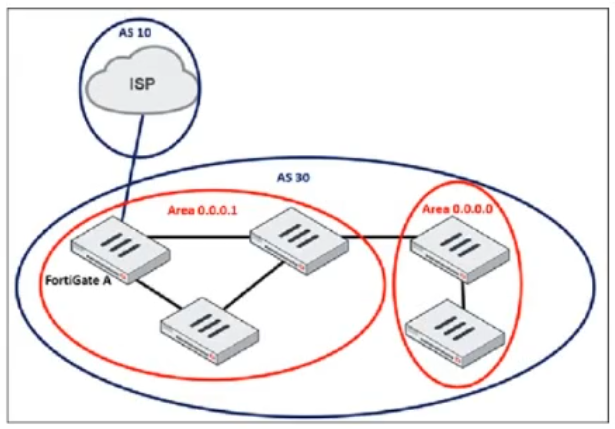
Refer to the exhibit. An enterprise network that is connected to an ISP is shown. ![Question Image](https://cdn.examcademy.com/images/questions/1783911260807-nk3ojxxz.png) You must configure a loopback as the BGP source for connecting to the ISP. Which two commands must be used to establish the connection? (Choose two.)
Aibgp-enfогсе-multihop
Bebgp-enfоrce-multihop
Crecursive-next-hop
Dupdate-source
Question #2Part 1Security profiles

To protect your enterprise network traffic, which action does FortiGate perform first when processing the initial packets of a session?

ADecryption
BInstallation of the session key in the network processor (NP)
CA reverse path forwarding (RPF) check
DIP integrity header checking
Question #3Part 1RoutingSelect 2

In which two ways does FortiGate utilize the Internet Service Database (ISDB) in firewall policies and SD-WAN rules? (Choose two.)

AThe ISDB works in proxy mode, allowing the analysis of packets in layers 3 and 4 of the OSI model.
BThe ISDB blocks the IP addresses and ports of an application predefined by FortiGuard.
CThe ISDB limits access by URL and domain.
DFortiGate has a predefined list of all IP addresses and ports for specific applications downloaded from FortiGuard.
Question #4Part 1VPNSelect 2

You want to deploy ADVPN efficiently across the enterprise network. Which two approaches can help enable this deployment? (Choose two.)

AOn FortiGate, utilize loopback interfaces to reduce the number of routes and peers.
BOn FortiManager, enable ADVPN on VPN Manager.
COn FortiGate, connect only the links with the best status.
DFortiManager, activate the recommended IPsec tunnel provisioning templates and enable ADVPN.
Question #5Part 1System configuration

Refer to the exhibit. ![Question Image](https://cdn.examcademy.com/images/questions/1783911454432-wekmqpf2.png) An HA configuration for an active-active (A-A) cluster with the same HA uptime is shown. You want HQ-NGFW-2 to handle the Core2 VDOM traffic. Which modification must you make to accomplish this?

AEnable override in virtual duster 2 for HQ-NGFW-2.
BChange the priority from 120 to 200 for HQ-NGFW-2.
CChange the priority from 100 to 160 for HQ-NGFW-2.
DReboot HQ-NGFW-2.
Question #6Part 1Routing

Refer to the exhibit. ![Question Image](https://cdn.examcademy.com/images/questions/1783920802653-ua02rkl0.png) You must modify the MED value that FortiGate_1 advertises to a BGP neighbor in autonomous system AS 30. Which parameter must be configured on FortiGate_1 to implement this?

Adistribute-list-out
Broute-map-out
Cprefix-list-out
Droute-overlap
Question #7Part 1Routing

You need to scale IBGP sessions and optimize the routing table in an IBGP network. Which parameter should be configured?

Aneighbor-group
Bneighbor-range
Crecursive-next-hop
Droute-reflector-client
Question #8Part 1VPNSelect 2

Refer to the exhibits. ![Question Image](https://cdn.examcademy.com/images/questions/1783911433825-ekqjz2l7.png) The exhibit shows the ADVPN network topology and a partial BGP configuration. Which two parameters must be configured under `config neighbor-range` for the spokes shown? *(Choose two.)*

Aset prefix 10.0.12.0 255.255.255.0
Bset route-reflector-client enable
Cset neighbor-group advpn
Dset prefix 172.16.1.0 255.255.255.0
Question #9Part 1Security profiles

You need to update a firewall policy to block multiple websites for the subnet `172.165.58.0/24`. What must you do to block these addresses efficiently?

ACreate an application sensor and apply the application control profile to the firewall policy.
BCreate a URL niter and apply the web filter profile to the firewall policy.
CCreate an IP address external connector and apply it to the destination field of the firewall policy.
DCreate an Internet Service Database (ISDB) group and apply it to the destination field of the firewall policy.
Question #10Part 1VPN

Refer to the exhibit. A partial VPN configuration is shown. ![Question Image](https://cdn.examcademy.com/images/questions/1783911431715-kjii568i.png) Which statement about this VPN IPsec Phase 1 configuration is correct?

AFortiGate will not add a route to its routing information base (RIB) or forwarding information base (FIB) when the dynamic tunnel is negotiated.
BThis configuration must include certificates associated peer IDs to enhance security.
CA separate interface is created for each dial-up tunnel, which can be slower and more resource intensive, especially in large networks.
DThis configuration is the best for networks with regular traffic intervals, providing a balance between connectivity assurance and resource utilization.
Question #11Part 1Central management

Refer to the exhibit. A revision-history window at the FortiManager device layer is displayed. ![Question Image](https://cdn.examcademy.com/images/questions/1783911460051-zugrgwr1.png) The IT team is attempting to identify the administrator responsible for the latest update to the FortiGate device database. What can the IT team conclude?

AThe user script_manager, an API user from the Fortinet Developer Network (FDN). is retrieving a configuration.
BThe retrieve process was automatically triggered by a Remote FortiGate Directly (via CLI) script.
CTo identify the user who created the event, in the FortiManager system logs, they must use the type=script filter in the user field.
DTo identify the user who created the event, they must view it on the Configuration and Installation widget on FortiGate at the FortiManager device layer.
Question #12Part 1Security profilesSelect 2

Refer to the exhibit. ![Question Image](https://cdn.examcademy.com/images/questions/1783920797135-co6y6zk4.png) The packet-capture output for a ClientHello message is displayed. You are updating a firewall policy that includes SSL certificate inspection. You are capturing packets from traffic traversing this firewall policy. Which two statements about the packet capture are correct? (Choose two.)

AThe subject alternative name (SAN) is necessary to apply security profiles.
BThe client support only TLS versions 1.2 and 1.3.
CYou can effectively apply a web filtering profile to this traffic.
DYou can effectively apply an antivirus security profile to this traffic.
Question #13Part 1Central management

Refer to the exhibits. ![Question Image](https://cdn.examcademy.com/images/questions/1783911445274-8dzkg3oz.png) A policy-package conflict status and details from the import-device wizard in the Core1 VDOM are displayed. When importing a policy package, the following message is shown for the **Web_restrictions** web filter profile and the **deep-inspection** SSL-SSH profile: > The following objects were found having conflicts. Please confirm your settings, then continue. The **Web_restrictions** and **deep-inspection** profiles are used by other FortiGate devices within FortiManager. Which step must you take to resolve the issue?

ACreate uniquely named objects on FortiGate and reimport them into the policy package.
BRetrieve the FortiGate configuration to automatically export correct objects and policies.
CUse non-default object values because FortiManager is unable to alter default values.
DSelect the FortiManager configuration that accepts changes on FortiManager and preserves existing configurations on FortiGate devices.
Question #14Part 1System configuration

Refer to the exhibits. ![Question Image](https://cdn.examcademy.com/images/questions/1783911449131-fjxy66su.png) The configuration of the Windows PC, PC1, which has a default MTU of 1500 bytes, the FortiGate interfaces with an MTU of 1000 bytes, and the results of PC1 pinging server 172.16.0.251 are shown. Why is the PC1 user unable to ping server 172.16.0.254 and receiving the message: `Packet needs to be fragmented but DF set`?

AThe user must adjust the TCP maximum segment size (MSS) to 1000 for the ping to succeed
BThe ip.flags.mf option must be enabled on FortiGate. The user must adjust the ping MTU to 1000 to succeed.
CThe user must account for the size of the Ethernet header when configuring the MTU value.
DFortiGate honors the do not fragment bit and the packets are dropped. The user must adjust the ping MTU to 972 to succeed.
Question #15Part 1Central management

Refer to the exhibits. ![Question Image](https://cdn.examcademy.com/images/questions/1783911256351-c6e8cvlc.png) The system-administrator settings on a root FortiGate and the Security Fabric settings on a downstream FortiGate are displayed. When prompted to sign in to the downstream FortiGate using Security Fabric, a user enters the single sign-on (SSO) provider credentials. What happens next for the user?

AThe user is redirected to the root FortiGate.
BThe user accesses the downstream FortiGate with super_admin_readonly privileges.
CThe user accesses the root FortiGate with AdminSSO privileges.
DThe user receives an authentication failure message.
Question #16Part 1VPN

Refer to the exhibit. ![Question Image](https://cdn.examcademy.com/images/questions/1783920802274-y6w2onbl.png) The network diagram shows Site 2 being added with a network segment that overlaps the existing VPN IPsec connection between the hub and Site 1. Which IPsec Phase 2 configuration must be made on the FortiGate hub to enable equal-cost multipath (ECMP) routing when multiple remote sites connect using overlapping subnets?

ASet multipath to enable
BSet net-device to ecmp
CSet route-overlap to allow
DSet route-overlap to either use-new or use-old
Question #17Part 1Security profiles

Which action can be taken on FortiGate to block traffic through intrusion prevention system (IPS) protocol decoders, with emphasis on network transmission patterns and application signatures?

AEnable inspect all ports in flow mode
BUse application control to limit non-URL-based software handling.
CEnable application detection-based SD-WAN rules.
DUse the DNS filter to block application signatures and protocol decoders.
Question #18Part 1Central management

Refer to the exhibits. ![Question Image](https://cdn.examcademy.com/images/questions/1783920807870-ana8grjy.png) The system-administrator settings on a root FortiGate and the Security Fabric settings on a downstream FortiGate are displayed. When signing in with Security Fabric to the downstream FortiGate, a user enters the single sign-on (SSO) provider credentials. What is the outcome?

AThe downstream FortiGate creates an SSO administrator account for AdminSSO with the super_admin profile.
BThe user accesses the downstream FortiGate with super_admin_readonly profile.
CThe user is prompted to create an administrator account for AdminSSO.
DThe downstream FortiGate relies on the root FortiGate and does not create an administrator account.
Question #19Part 1VPN

You need to enable direct communication among multiple spokes in an organization’s network. Each spoke has more than one Internet connection. The spokes must connect directly, without traversing the hub, and the links must automatically switch to the best available connection. How can automatic detection and optimal link utilization between spokes be achieved?

ASet up OSPF routing over dynamic VPN tunnels between spokes.
BUse ADVPN 2.0 to facilitate dynamic direct tunnels and automatic link optimization.
CImplement SD-WAN policies at the hub and the spokes.
DEstablish dynamic VPN tunnels between spokes with predefined backup routes.
Question #20Part 1Routing

Refer to the exhibits. ![Question Image](https://cdn.examcademy.com/images/questions/1783920698210-uweovl8a.png) ![Question Image](https://cdn.examcademy.com/images/questions/1783920704622-jo2edfq1.png) ![Question Image](https://cdn.examcademy.com/images/questions/1783920709194-z2eeltdi.png) The routing tables for FortiGate_A and FortiGate_B, along with a network topology, are displayed. Why does FortiGate_B have only one external route available for `100.75.5.1/32`?

AThe subnet 10.0.11.0/24 is not located in the FortiGate_B area.
BFortiGate_A advertises only one external route to FortiGate_B.
CThe route to 100.75.5.1/32 shown on FortiGate_B has the lowest cost.
Drfc-1583-compatible is not set to enable on FortiGate_B.
Question #21Part 1System configuration

Refer to the exhibit. ![Question Image](https://cdn.examcademy.com/images/questions/1783920693466-gql6vmzg.png) FortiGate_A and FortiGate_B are members of a FortiGate Session Life Support Protocol (FGSP) cluster in an enterprise network. While testing the cluster with the `ping` command, you monitor packet loss and see the displayed session-list output on FortiGate_B. What is causing this output on FortiGate_B?

Asession-pickup-connectionless is set to disable on FortiGate_B.
BThe session synchronization is encrypted.
CFortiGate_B is configured in passive mode.
Dstandalone-config-sync is set to disable on FortiGate_B.
Question #22Part 1VPN

When implementing IKEv2 in a VPN topology, which two statements are correct?

AUnlike IKEv1, it supports mode config.
BIt includes stronger Diffie-Hellman (DH) groups, such as Elliptic Curve (ECP) groups.
CIt supports the extensible authentication protocol (EAP).
DIt exchanges a minimum of two messages to establish a secure tunnel.
Question #23Part 1Security profiles

You receive a FortiAnalyzer alert warning that a 1 ТВ disk became full in one day. During the investigation, you find thousands of unusual DNS log requests, such as `JHCMQK.website.com`, with no answers. You later discover that DNS exfiltration is taking place through both UDP and TLS. How can you prevent this data-theft technique?

AUse a file filter profile to protect against DNS exfiltration.
BUse an intrusion prevention system (IPS) profile and DNS exfiltration-related signatures.
CEnable DNS filter to protect against DNS exfiltration.
DEnable data loss prevention (DLP) to prevent DNS exfiltration.
Question #24Part 1Security profilesSelect 2

While inspecting an enterprise network, you identify a suspicious packet with MAC address `00:09:0f:09:18:81`. Which two statements about this suspicious packet are correct? (Choose two.)

AThe suspicious packet is related to a cluster with a group-id value lower than 255.
BThe suspicious packet corresponds to a port with a physical index equal to 2.
CThe suspicious packet is related to a cluster that has VDOMs enabled
DThe suspicious packet is related to a cluster configured with the FortiGate Session Life Protocol (FGSP).
Question #25Part 1RoutingSelect 2

Refer to the exhibit. ![Question Image](https://cdn.examcademy.com/images/questions/1783911431965-uagpuby2.png) A network diagram shows a hub-and-spokes deployment. You must deploy several spokes, including BGP configuration for the spokes that connect to the hub. Which two commands would you use to minimize the configuration required on the hub? (Choose two.)

Aebgp-multipath
Broute-overlap
Cneighbor-range
Dneighbor-group
Question #26Part 1Central management

You have configured the FortiGate devices in an enterprise network to join the Fortinet Security Fabric. You have a list of IP addresses that must be blocked by the data center firewall, and the list is updated daily. How can you automate firewall-policy updates to add the IP addresses from the daily updated list?

AWith an external connector from External Feeds
BWith metadata variables in FortiManager
CWith a CLI script in FortiManager
DWith a Security Fabric automation
Question #27Part 1Central managementSelect 3

An organization has acquired multiple branches in different countries and must install FortiGate devices at every branch. However, its IT staff does not have the knowledge needed to implement the initial configuration on the FortiGate devices. Which three approaches can the organization use to successfully deploy advanced initial configurations on the FortiGate devices at its remote branches? (Choose three.)

AApply Jinja in the FortiManager scripts for large-scale and advanced deployments.
BUse provisioning templates and install configuration settings at the device layer.
COn FortiManager, add the FortiGate devices as model devices, and use zero-touch provisioning (ZTP) or low-touch provisioning (LTP) to connect to the FortiGate devices.
DUse the global ADOM to deploy global object configurations to each FortiGate device.
EUse metadata variables to dynamically assign values according to each FortiGate device.
Question #28Part 1System configuration

A vulnerability-scan report revealed that a user generated traffic to the website `example.com` using a weak SSUTLS version supported by the HTTPS web server. What can you do to block every outdated SSL/TLS version on any HTTPS web server and prevent possible attacks on user traffic?

AEnable server certificate SNI check in the SSL/SSH inspection profile.
BEnable auto-detection of outdated SSL/TLS versions in the SSL/SSH inspection profile to block vulnerable websites.
CBlock invalid SSL certificates in the SSL/SSH inspection profile.
DConfigure the unsupported SSL version and set the minimum allowed SSL version in the HTTPS settings of the SSL/SSH inspection profile.
Question #29Part 1VPN

You are configuring ADVPN and want to make sure that peer IDs are not revealed during VPN establishment. Which protocol can the administrator use to improve security?

AUse SSL VPN tunnel mode with certificates.
BUse IKEv2, which encrypts peer IDs and prevents exposure.
CUse IKEv1 aggressive mode with certificates.
DUse IKEv1 main mode with AES-GCM security proposal.
Question #30Part 1Routing

Refer to the exhibit. The status of a newly configured BGP session on FortiGate is displayed. ![Question Image](https://cdn.examcademy.com/images/questions/1783911455685-5gseivo1.png) Based on the output in the exhibit, which configuration should be considered next?

AContact the remote peer administrator to enable BGP.
BConfigure a static route to 100.65.4.1.
CEnable ebgp-multipath.
DEnable ebgp-enforce-multihop.
Question #31Part 1Central managementSelect 2

Refer to the exhibit. ![Question Image](https://cdn.examcademy.com/images/questions/1783911447991-jx0hrp5y.png) A normalized interface named LAN on FortiManager is displayed. Which two statements about this interface configuration are correct? (Choose two.)

AThe normalized interface LAN will be mapped to the private interface for FortiGate-VM64 model devices.
BThe normalized interface LAN will be mapped to the wireless interface for FortiGate-81E model devices.
CThe normalized interface LAN will be mapped to the port2 interface for NGFW-1 [Core2].
DThe normalized interface LAN will be mapped to the Human Resources interface for any FortiGate-40F model devices.
Question #32Part 1RoutingSelect 2

Refer to the exhibit. Partial output from an OSPF command is displayed. ![Question Image](https://cdn.examcademy.com/images/questions/1783911453040-cshlx7w3.png) While checking the OSPF status on FortiGate, you receive the output shown in the exhibit. Based on the output, which two statements about FortiGate are correct? (Choose two.)

AFortiGate injects external routing information.
BFortiGate is a backup designated router.
CFortiGate is connected to multiple areas.
DFortiGate has OSPF ECMP enabled.
Question #33Part 1Security profiles

You applied a block-all intrusion prevention system (IPS) profile for client and server targets to protect the server, but the database team reported that applications stopped functioning immediately afterward. How can you deploy IPS so that it does not interrupt existing applications on the network?

ASet the IPS profile signature action to default and verity patterns.
BUse an IPS profile with all signatures in monitor mode and verify patterns before blocking.
CLimit the IPS profile to server targets only and set the action to default.
DSelect flow mode in the IPS profile and monitor the application patterns.

📢 Unlock Full Access to Success!

"The content displayed here is a promotional preview and contains only 50% of the actual exam database. To access the complete set of updated questions, please upgrade to the Full Version."

👉 Click the button and follow the instructions to secure your full access immediately!